
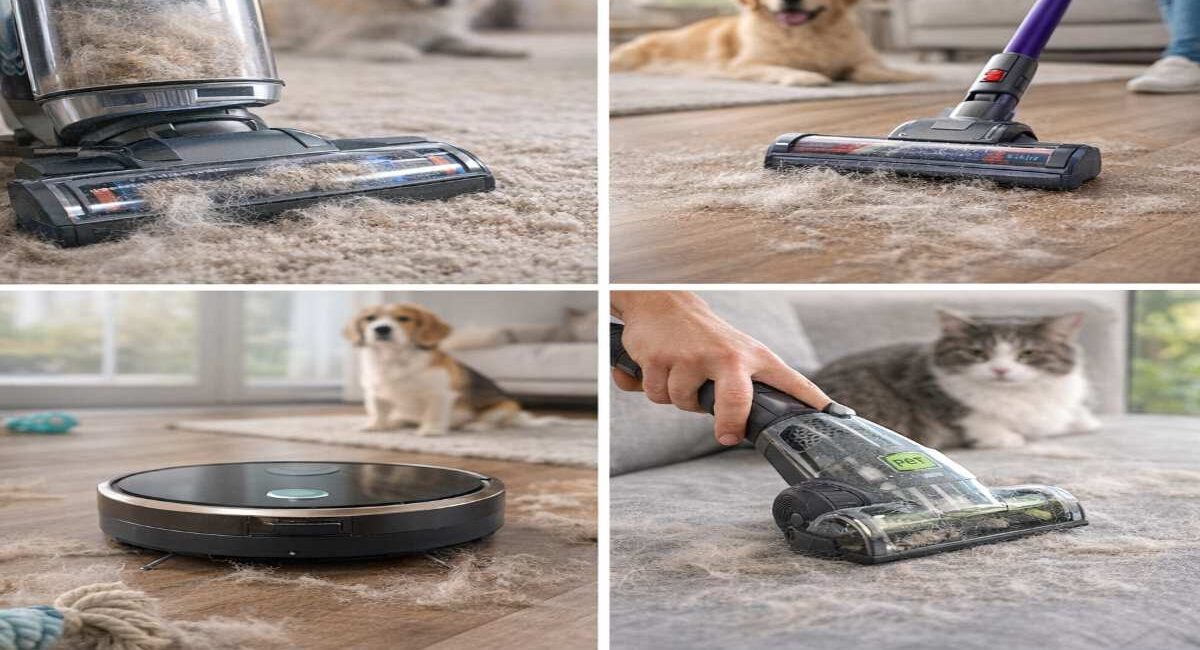
What constitutes the best vacuum for pet hair isn’t a single product but one which fits your shedding patterns, home configuration, and floor coverings. Appearance isn’t based on marketing hyperbole but on airflow/hardness engineering and brush arrangement.
If you’re here, you likely want a direct answer:
While for high-shedding dogs and thick carpets, a powerful straight with a distinct brush roll works best. In terms of quick cleanups on a daily basis or smaller flats, a high-quality battery-powered stick vacuum might simply be the practical solution.
Let’s now consider the reasons why.
Why Pet Hair Is Harder Than Regular Dust
Pet hair behaves differently from normal debris.
- It embeds deep into carpet fibres.
- It wraps around brush rolls.
- It clings to upholstery due to static.
- It carries dander that affects allergies.
Removing pet hair requires agitation (brush action) plus airflow—not just suction.
What Actually Makes a Vacuum Good for Pet Hair
Brush Roll Engineering
Motorized brush rolls lift hair from carpets.
Look for:
- Anti-tangle fins
- Self-cleaning brush bars
- Rubberized rollers (better for hard floors)
Traditional bristles alone often clog quickly.
Airflow & Suction Path
Marketing often highlights “high suction power.”
But what matters is:
- Consistent airflow
- Efficient internal air pathways
- Minimal clogging design
Air watts (used in engineering testing) are more meaningful than vague suction claims.
Filtration & Sealed Systems
If allergies matter:
- Look for HEPA filtration.
- Confirm the vacuum is fully sealed—not just “HEPA filter included.”
A sealed system ensures captured allergens don’t leak back into the air.
Maintenance & Hair Wrap Prevention
Ask:
- Can you remove the brush roll easily?
- How often do filters need replacement?
- Are parts washable?
Maintenance determines long-term satisfaction.
Upright vs Cordless vs Canister vs Robot
| Type | Best For | Pros | Cons |
| Upright | Thick carpets, large homes | Strong agitation | Heavier |
| Cordless Stick | Apartments, quick cleanup | Lightweight, convenient | Battery limits |
| Canister | Mixed floors | Flexible, powerful | Storage space |
| Robot | Daily maintenance | Automated | Not deep-cleaning |
Robot vacuums help maintain cleanliness—but rarely replace deep cleaning in pet households.
Best Type of Vacuum by Home Scenario
Heavy Shedding Large Dog + Carpeted Home
Choose:
- Upright
- Strong motorized brush
- Large dust
Illustrative example:
A Labrador in a 2,000 sq ft house with a carpet floor needs powerful cleaning equipment every week—deep cleaning, not a stick.
Small Apartment + Cat
Choose:
- Cordless stick vacuum
- Easy storage
- Lightweight design
Quick daily cleaning prevents buildup.
Multiple Pets + Mixed Flooring
Choose:
- Hybrid upright or high-end cordless
- Adjustable brush roll
- Sealed HEPA system
Allergy-Sensitive Household
Prioritize:
- Fully sealed HEPA system
- Strong suction consistency
- Easy filter replacement
Features That Matter
Actually Useful
- Anti-hair wrap technology
- Adjustable suction
- LED floor lights
Overhyped
- Extreme cyclone counts
- Inflated suction numbers
- Fancy app features (if basic cleaning is weak)
Budget vs Premium: What You Gain
| Price Range | What You Get | Trade-Off |
| Under $200 | Basic cleaning | Lower durability |
| $200–$500 | Strong motor, better brush | Moderate lifespan |
| $500+ | Advanced anti-tangle, sealed HEPA | Higher cost |
Premium models often improve durability and filtration—not just suction.
Common Mistakes When Buying
- Choosing robot vacuum as only solution
- Ignoring filter cost
- Not considering storage space
- Buying based on brand reputation alone
Performance depends on design, not logo.
Final Decision Matrix
Before buying, ask:
- How much does your pet shed?
- What flooring dominates your home?
- Do you have allergy concerns?
- Do you prefer convenience or deep cleaning?
- What’s your realistic budget?
The best vacuum for pet hair is the one that solves your specific shedding problem—not the one topping generic lists.