
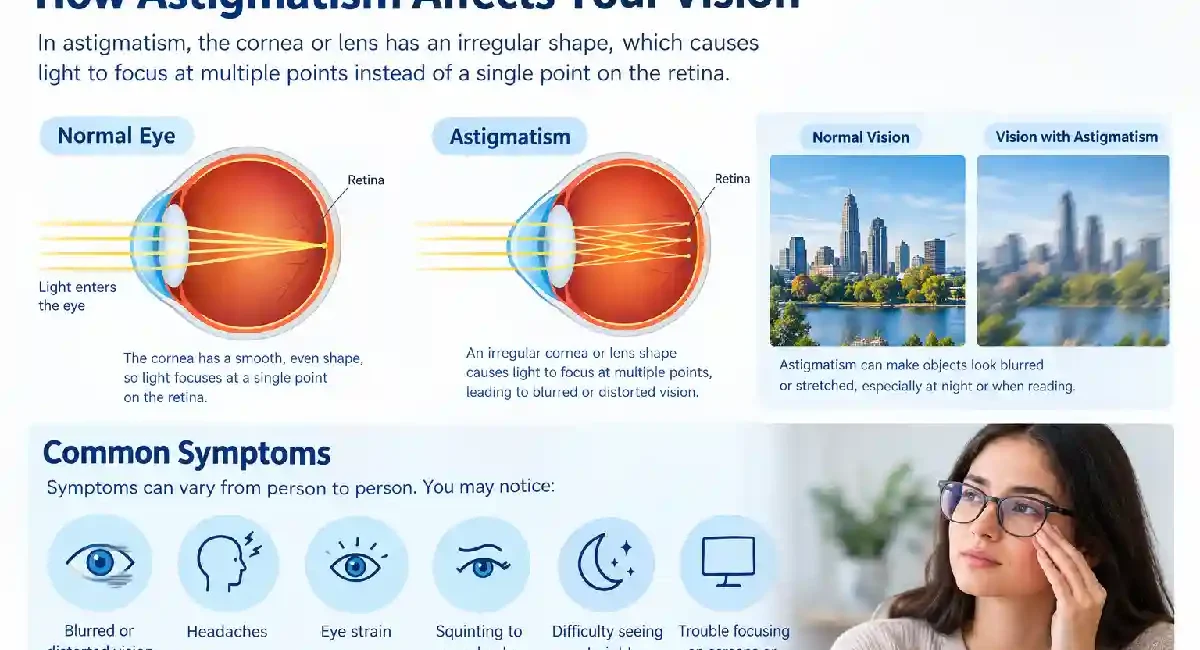
Have you caught the odd glance in the mirror and thought your vision is just a little skewed? Things seem a little hazy or warped? You may have the eye condition astigmatism. Anybody can suffer from astigmatism.
The good news is that astigmatism can usually be known during an eye check and modified with fit treatment.
This Article Is Belongs To The Self Care
What Is Astigmatism?
Have you ever noticed your vision not quite right? A misshapen cornea could mean you have astigmatism. What does that mean for you? Light focus, which impacts your near and distance vision.
Astigmatism is classified as a refractive error, alongside conditions such as myopia, hyperopia & presbyopia. It may be present from childhood or develop later. Eye injury and some eye conditions or surgeries can also affect the shape of the eye.
Common Symptoms
Symptoms vary according to the amount of astigmatism and whether another refractive error is present. Common signs include:
- Blurred or distorted vision
- Headaches
- Eye strain
- Squinting to see clearly
- Difficulty seeing clearly at night
- Worry focusing in prolonged reading or screen use
Less severe cases may have very few or no detectable symptoms, another reason why searching for these conditions during routine eye examinations is important.
What Causes Astigmatism?
Sometimes there is no clear cause. Some babies are born with an abnormally shaped cornea or lens; and others develop changes when they are young.
Ever questioned your eyes after an injury or operation? Could be astigmatism. You might think, ‘I can diagnose this,’ but here’s the thing: it’s connected to other diseases in the eye, such as keratoconus. Isn’t your vision now worth a professional?
Astigmatism vs Other Refractive Errors
| Condition | Typical vision problem | Main area involved |
| Astigmatism | Blurred and distorted vision at the different distances | Cornea & lens shape |
| Myopia | Distant objects appear blurred | Eye shape/focusing system |
| Hyperopia | Near objects may appear blurred | Eye shape/focusing system |
| Presbyopia | Difficulty focusing on close objects with age | Lens flexibility |
These conditions could be present independently or together, a trial eye examination would be required to determine correct medication.
How Is Astigmatism Diagnosed?
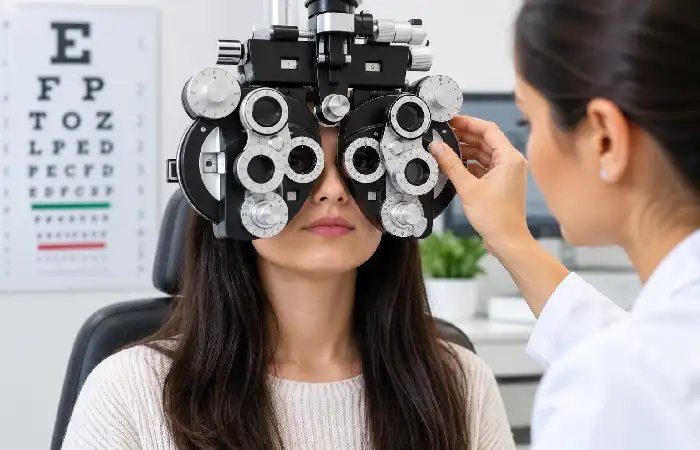
An Optometrist or extra fit eye-care professional can test for astigmatism during a full eye test.
Typical eye-test workflow
- Vision assessment → 2. Refraction testing → 3. Eye health examination → 4. Prescription and treatment discussion
Have you ever wondered what occurs during an eye exam? You might be asked to read the alphabet or symbols from different distances. The refraction test determines the specific prescription for your eyes to see more clearly.
Treatment Options for Astigmatism
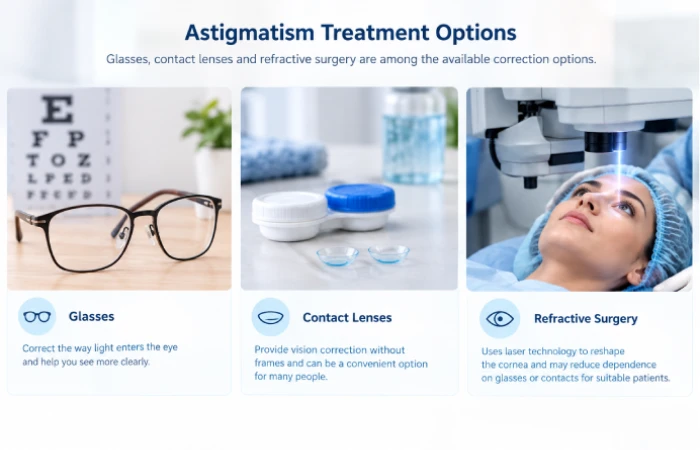
The treatment will be decided by the level of the refraction, your needs and the general condition of the eye.
| Treatment | How it works | Main consideration |
| Prescription glasses | Correct the way light enters the eye | Simple, non-invasive option |
| Contact lenses | Correct vision while sitting directly on the eye | Requires correct fitting and hygiene |
| Refractive surgery | Changes the shape of the cornea | Requires careful suitability assessment |
| No treatment | May be appropriate for some mild cases | Requires professional assessment |
More than 90 per cent of Americans use some form of glasses or contact lenses. A few individuals will be candidates for a type of refractive surgery, such as LASIK, but that’s not an option for everyone. A
Glasses
Ever think about how prescription glasses work? They simply correct visual defects. They won’t change the shape of your eyes but they will deflect light in the right direction and focus it onto your retina.
Advantages:
- Non-invasive
- Easy to use
- No contact with the eye
- Suitable for many people
Limitations:
- Need to be worn to provide correction
- Frames can be inconvenient for some activities
- Prescription may need updating as vision changes
Contact Lenses
Contacts – No Frames One company makes contact lenses that correct vision. Some lenses are custom made to fix astigmatism.
They are convenient for sport and other activities but should be properly fitted, cleaned and replaced. Not washing your hands before inserting contact lenses can cause eye infections.
Refractive Surgery
Laser assisted in-situ keratomileusis (LASIK) and other procedures With laser technology it is possible to change the shape of your cornea. Suitable candidates for laser correction will have healthy eyes and a stable prescription.
LASIK Side Effects and Risks Other side effects may include dry eye, glare, halos, double vision or temporary blurred vision. Serious but rare complications are possible.
Realistic Expectations: What Can Treatment Do?
Curious as to why glasses and contacts aren’t as effective when they’re not on your face? Because they don’t actually change your eye! With some surgery, you may be able to get to the point where you don’t need them as much, but it’s not guaranteed to give you perfect vision or presbyopia.
Are you getting head aches, bad vision even after a lens change? Don’t just change your lenses, get another eye exam!
Who Should Have an Eye Examination?
Is this making you squint? If the blurred vision you’re experiencing, headache if you’re concentrating, eye strain or poor night vision sound like your symptoms, it’s probably time for an eye test.
Children should be tested for vision as well because they may not realize their vision is blurry. Children with refractive errors that aren’t corrected can develop amblyopia if one eye can see better than the other.
Pros and Limitations of Common Treatments
Glasses
- Pros: Simple, safe and non-invasive.
- Limitations: Must be worn for correction and may be inconvenient for some activities.
Contact lenses
- Pros: No frames and useful for active lifestyles.
- Limitations: Require careful hygiene and may not suit everyone.
Refractive surgery
- Pros: Can reduce dependence on glasses and contact lenses the suitable patients.
- Limitations: Involves surgical risks & is not suitable for every eye & prescription.
When Should You Seek Professional Advice?
These are all good incentives to book an eye test, but should not be taken to be astigmatism unless the degree of myopia has increased gradually. Sudden or severe changes should be evaluated by a healthcare professional.
FAQ’s
Can astigmatism go away on its own?
Interested about why the astigmatism can’t just leave on its own? For that, it is the shape of your cornea and the lens. To get you up to speed: some cases don’t require correction, but some can greatly improve with glasses, contacts, and other options.
Does astigmatism cause blurry vision?
Yes. It can lead to blurred or distorted vision at near and far distances night vision problems can also occur.
Can children have astigmatism?
Yes. Children can have astigmatism, & it is important to diagnose any significant visual problems, as refractive errors will affect visual development.
Can astigmatism be corrected with glasses?
Yes. However, it is another question. prescription glasses are other common way to corrected astigmatism and other disorders.
Is LASIK suitable for everyone with astigmatism?
No. LASIK suitability depends on factors such as eye health, corneal condition and prescription stability. A comprehensive eye examination is required before considering surgery.
Conclusion
Yes, and it is a common condition that causes distorted vision, eye strain and other visual symptoms. An eye exam can identify astigmatism because many visual symptoms are similar to othervision conditions.
Ever thought about the prescription glasses or contact lenses get the clear view of the healthy? Refractive surgery is also a risky way. There is need for your eye and vision correction specialist expert’s decision if necessary or choose both. It depends on your corrective lens, your eye condition, and the lifestyle needs and preferences.