
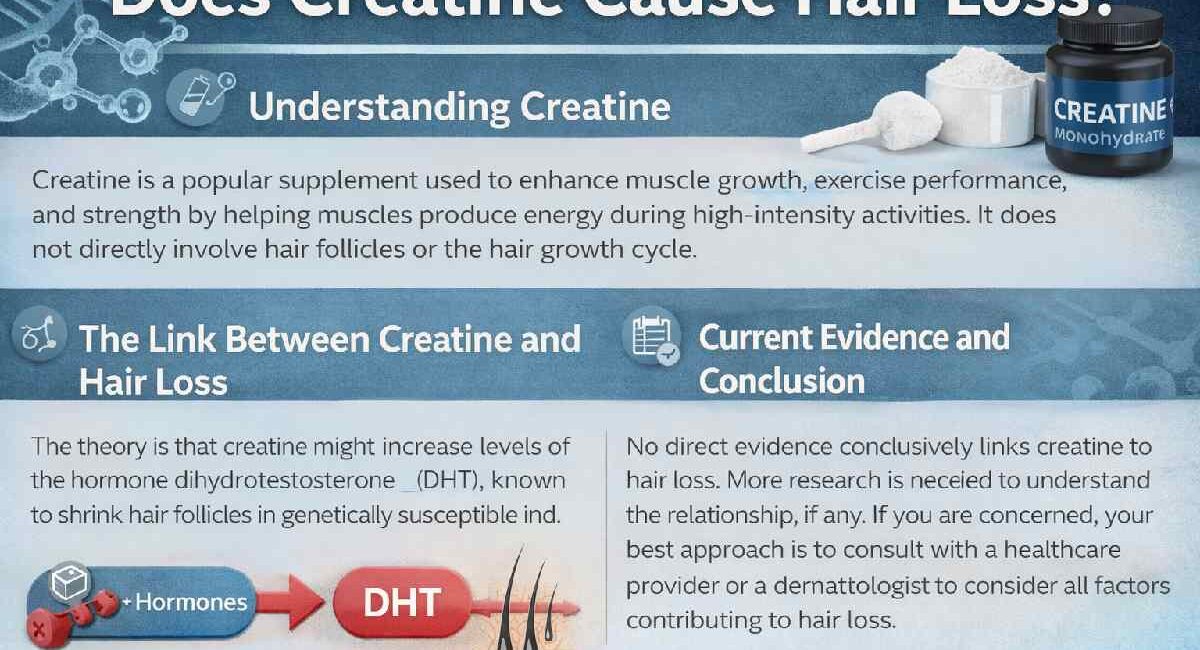
Does Creatine Cause Hair Loss? What the Evidence Actually Says
Creatine does not directly cause hair loss, but it may accelerate hair loss in people who are already genetically susceptible by potentially influencing DHT-related pathways—an effect that remains theoretical and not conclusively proven.
If you’ve searched “does creatine cause hair loss,” you’re probably stuck between gym advice saying “you’ll go bald” and science threads saying “there’s no evidence.” That uncertainty is the problem. The agitation is real because hair loss is permanent, while creatine is one of the most effective and well-studied supplements for strength and performance.
The solution is separating what’s actually been studied from what’s been assumed, misunderstood, or exaggerated. The short, clear answer: creatine itself has not been shown to cause hair loss—but context, genetics, and hormones matter.
Who This Article Is For (and Not For)
This article is for:
-
Beginners worried about starting creatine.
-
Lifters already using creatine and noticing shedding.
-
Coaches and health professionals who want evidence-based clarity.
This article is not for:
-
People looking for a definitive medical diagnosis.
-
Anyone expecting creatine to create hair loss out of nowhere.
Hair loss is a medical topic (YMYL-adjacent), so this article explains evidence—not personal medical advice.
Where the Hair Loss Fear Comes From
Nearly all concern traces back to one study.
The 2009 Rugby Study
-
Conducted on male rugby players.
-
Found an increase in DHT (dihydrotestosterone) after creatine loading.
-
Did not measure hair loss.
-
Did not track long-term outcomes.
DHT is strongly associated with androgenetic alopecia (male pattern baldness), which is why this study became internet legend.
Organizations like the International Society of Sports Nutrition (ISSN) and researchers publishing in journals such as The Journal of the International Society of Sports Nutrition consistently note that this study has never been replicated.
What DHT Actually Does
DHT:
-
Is a derivative of testosterone.
-
Plays a major role in genetically driven hair follicle miniaturization.
-
Does nothing to hair follicles that are not genetically sensitive.
What the Broader Creatine Research Shows
Creatine is one of the most studied supplements in sports nutrition.
Across decades of research:
-
No large randomized controlled trials link creatine to hair loss.
-
Long-term studies focus on muscle, cognition, hydration, and kidney safety.
-
Hair loss is not reported as a consistent adverse effect.
Authorities frequently referenced on this topic include:
-
International Society of Sports Nutrition (ISSN)
-
Mayo Clinic (for hair loss mechanisms)
-
Cleveland Clinic (for androgenetic alopecia explanations)
If creatine reliably caused hair loss, it would appear in post-market safety data. It hasn’t.
The Conditional Risk Model
Instead of “yes or no,” the real question is “under what conditions?”
Scenario Comparison Table
| Person Type | Genetics | Creatine Use | Likely Outcome |
| No family hair loss | Low sensitivity | Yes | No effect |
| Early hair thinning | High sensitivity | Yes | Possible acceleration |
| Balding already | Very high sensitivity | Yes | No new cause, may notice timing |
| No creatine use | High sensitivity | No | Hair loss still occurs |
This framework explains why anecdotes exist without proving causation.
Why Anecdotes Feel Convincing
Common failure patterns in reasoning:
-
Timing bias: Starting creatine at the same age hair loss normally begins (late teens to 30s).
-
Confirmation bias: Noticing shedding only after reading about it.
-
Training effects: Heavy lifting can temporarily increase testosterone fluctuations, unrelated to creatine.
Hair shedding phases (telogen effluvium) can occur due to stress, diet changes, or intense training—often misattributed to supplements.
What Creatine Does Not Do
Creatine does not:
-
Damage hair follicles directly.
-
Cause hair loss in people without genetic predisposition.
-
Act like anabolic steroids.
-
Alter hormones dramatically in healthy individuals.
These distinctions are often lost in online discussions.
Practical Decision Guide
Ask yourself:
-
Do close male relatives have early hair loss?
-
Are you already noticing thinning?
-
Is creatine meaningfully improving your training or recovery?
Practical options:
-
Continue creatine and monitor hair objectively (photos over months).
-
Skip loading phases (purely optional anyway).
-
Stop creatine if anxiety outweighs benefits—stress itself can worsen hair shedding.
There is no performance benefit worth chronic stress.
Regional & Regulatory Note
Creatine monohydrate is:
-
Widely approved and regulated in the US and EU.
-
One of the most quality-controlled supplements globally.
Regulatory approval does not equal zero risk—but it does indicate extensive safety review.
Final Take
Creatine does not cause hair loss in the general population. The most accurate, evidence-based position is this: creatine may act as an accelerant in a very specific subset of genetically predisposed individuals—but it is not a root cause. If hair loss is in your future, creatine might change when you notice it, not whether it happens. Understanding that distinction is the difference between fear and informed choice.